Scam. Spam. Damn It. Why Did I Answer?

A physician imposter scam used real provider information, a fake government investigation, and one well-timed phone call to make an outrageous story feel possible.
And just like that, everything is a question and reality blurs.
On any given day, the unknown number goes unanswered. That is my go-to strategy. If I do not recognize you, voicemail exists for a reason. Apparently years of spam calls have trained me well.
But at that moment, on that day, at that time, the phone rang and my client answered.
He had a full waiting room, back-to-back patients, and very little space between one decision and the next. I happened to be in the office that day, so I watched the call unfold in real time instead of hearing the cleaned-up version afterward.
I am also a true-crime junkie. I have listened to enough stories about fraud, scams, impersonators, missing people, bad decisions, terrible decisions and the occasional person who should absolutely have known better to think I would recognize this stuff immediately.
What I did not know was how specifically physicians were being targeted with this particular kind of nonsense.
And that matters because these are not people walking around with no common sense.
These are physicians who, on any normal day, know better.
We all know better.
Do not click the weird link in the email. Do not open the attachment from someone you do not recognize. Do not give your password to the person who calls pretending to be Microsoft. Do not send gift cards to the IRS.
Until the story is about your medical license, your NPI, oxycodone crossing the Mexican border, a government investigation and the possibility that somebody has been using your identity.
Then, for a few minutes, everything you know can get a little blurry.
The Call
The caller said he was from the Nevada State Board of Pharmacy and provided a name and badge number. He told the physician that a large quantity of oxycodone had been intercepted crossing the Mexican border and that every bottle had his name on it. Then he started reciting information that was actually his: his NPI, his medical license number and other identifying details. Suddenly this was not some guy calling about an extended car warranty. There was just enough reality mixed into the story to make you wonder what the hell was happening.
Then the pressure started. There was supposedly an active investigation. He needed to stop seeing patients. He was not supposed to hang up. When he said he wanted to call his attorney, the caller did not want that to happen. The caller also asked for his wife's phone number, which immediately got my attention because she is also a physician.
Then came the bank accounts. The caller rattled off several accounts supposedly connected to him. Most were inaccurate. One was surprisingly correct.
And that was where logic started fighting its way back into the room.
Why would an investigator need him to identify which bank account was actually his? Why could he not call his attorney? Why was hanging up suddenly forbidden? Why was the caller collecting information while supposedly already possessing the results of this enormous investigation?
My reaction was pretty simple: prove it.
Not with an NPI. Not with a medical license number. Not with a badge number I cannot verify. Prove it somewhere outside the phone call you control.
Eventually reality snapped back into place and he hung up.
But hanging up did not instantly make the whole thing disappear.
That is another part of this I think gets lost when we tell these stories afterward.
The Call Ended. The Questions Didn’t.
It is easy to hear a story like this afterward and ask, “Why didn’t you just hang up?” I probably would have asked the same thing if I had not been standing there watching it happen. We all know not to click the weird link in an email. We all know not to give information to a stranger on the phone. Physicians know better too.
But knowing better when nothing is happening is different from having someone suddenly tell you that your name is tied to oxycodone crossing the Mexican border, they know your NPI and medical license number, there is supposedly an active investigation, and your ability to keep practicing may be at risk. Add a full waiting room and patients still needing to be seen, and for a few minutes the ridiculous and the possible start occupying the same space.
Eventually logic caught back up. The questions stopped making sense. The caller did not want him talking to his attorney. He wanted him to stay on the phone. He was throwing out bank accounts and waiting to see which one was real. The whole thing started collapsing under its own story, and the physician hung up.
But hanging up did not instantly make the concern disappear. There was still that lingering, irrational but very human question: What if some part of this is real? What if the DEA actually shows up? What if there was something from the Board that got missed? What if somebody really had used his information?
So the administrator’s first job was not reporting a scam. Her first job was making absolutely sure his license was intact and there was not some notice, investigation, letter, or other piece of information the practice had somehow missed. She checked online, contacted the Board, and started verifying the accusation from outside the phone call.
Only after that could reporting even become the next question.
And this is where the process became its own unnecessary mess.
There is no single obvious place that tells a physician or administrator, “This happened. Start here.” You find the DEA, the FTC, the FBI’s IC3 reporting system, the state licensing boards, different phone numbers, different forms, different instructions, and different explanations of who wants what. Some numbers work better than others. Some information is easier to find than others. Meanwhile, somebody has already spent part of the clinical day proving that a fake investigation was fake.
I honestly do not know whether every part of this incident was ultimately reported. By the time the administrator had verified the license and figured out what was real, she had already given this scam far more of her day than it deserved. After going through the reporting process myself, I can understand why someone might decide, Nothing happened, nobody lost money, the license is fine, let’s get back to work.
And if that is happening regularly, it raises a much bigger question about the numbers we do have.
This Is Bigger Than One Bad Phone Call
The FTC says people reported more than one million imposter scams in 2025 and nearly $3.5 billion in losses. Imposter scams accounted for nearly one out of every three fraud reports that year. About $920 million in reported losses were tied specifically to government impersonators. FTC: $3.5 Billion Lost to Imposter Scams in 2025
That is why I do not see this as a cute little “watch out for scammers” reminder.
At that volume, having the reporting information available before you need it makes sense.
Especially for physicians, APRNs, practice owners and administrators whose professional information is already publicly available and who are making decisions all day long with people waiting for them on the other side of the door.
An NPI is not a secret password.
A license number is not proof that the person calling has government access.
Caller ID is not verification.
And someone knowing something true about you does not make everything else they say true.
That distinction needs to become as automatic as don't click the weird link in the email.
So I Made the Thing I Wanted Us to Have That Day
I created the Stop the Scam Crib Card and downloadable reporting template because I do not think a physician or administrator should have to research three government agencies after something like this happens just to figure out where to start
If enough providers tell me they would use it, I may turn this into a simple app that walks someone through what to preserve, who to verify, and where to report the incident without making them research it while their schedule falls apart.
I consolidated the working numbers and verified reporting routes. I put the immediate steps in one place, along with what not to confirm, what information to preserve and where these incidents can actually be reported.
The point is not to turn anybody into a fraud investigator.
The point is to be able to pull something up on your phone and say, Okay. Hang up. Verify here. Report here. Save this. Do not give them anything else.
That is it.
I want providers to keep it on their phones. I want administrators and practice leaders to have it too. Not because everybody needs another healthcare PDF sitting in Downloads, but because this is one of those resources that becomes very useful the minute you wish you had it.
The downloadable Stop the Scam Crib Card will also point back to the live resource on zentara.health, because I do not want a static PDF becoming another outdated government-resource list. I will review and update the online version quarterly so the current reporting links, numbers and instructions have one permanent home.
Save the card. Put it somewhere you can actually find it. Give it to the people in your practice who would be dealing with the mess if one of these calls came through tomorrow.
Hopefully nobody ever needs it.
Given the numbers, I am not betting on that.
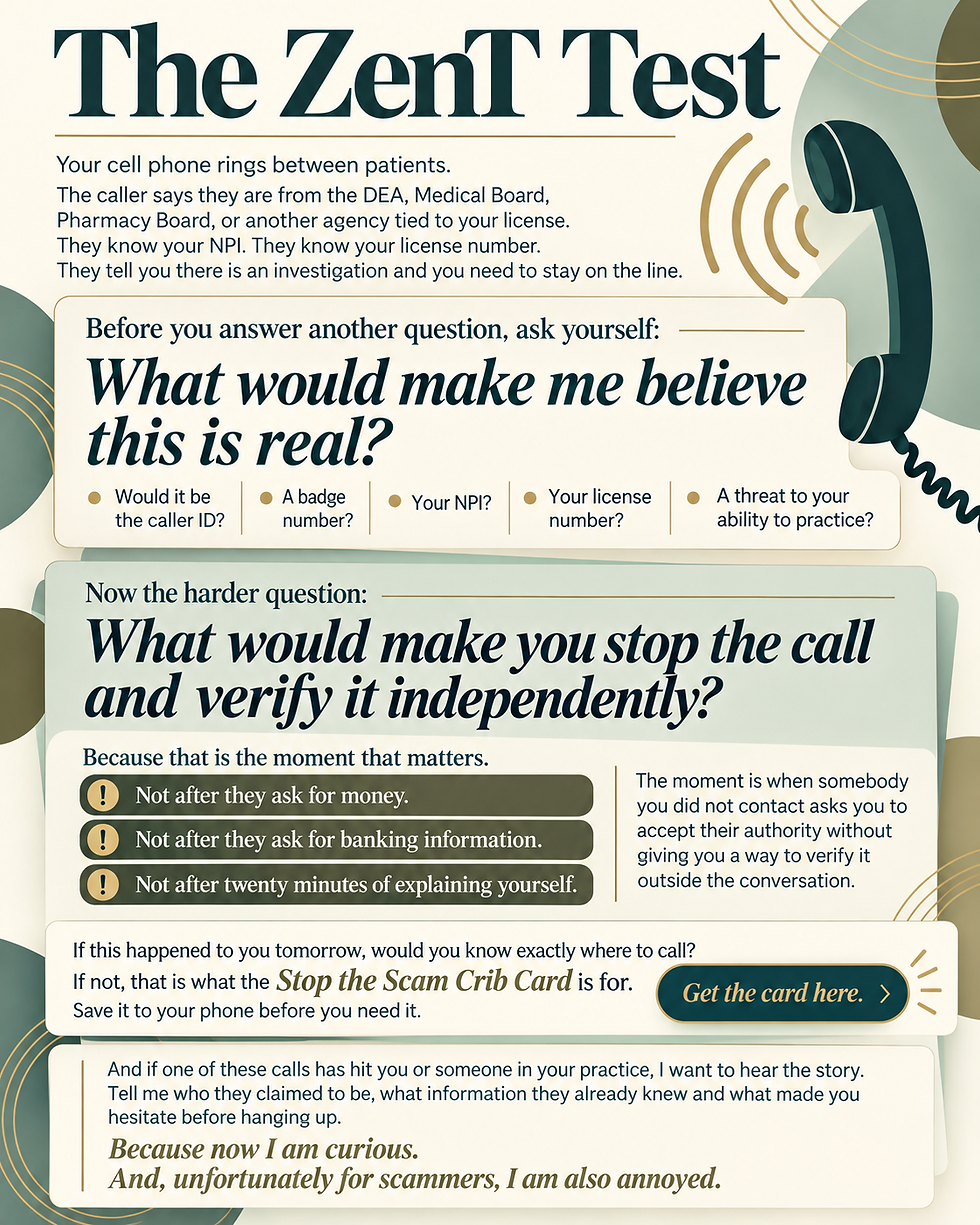
The ZenT Test
Your cell phone rings between patients.
The caller says they are from the DEA, Medical Board, Pharmacy Board, or another agency tied to your license. They know your NPI. They know your license number. They tell you there is an investigation and you need to stay on the line.
Before you answer another question, ask yourself:
What would make me believe this is real?
Would it be the caller ID?
A badge number?
Your NPI?
Your license number?
A threat to your ability to practice?
Now the harder question:
What would make you stop the call and verify it independently?
Because that is the moment that matters.
Not after they ask for money.
Not after they ask for banking information.
Not after twenty minutes of explaining yourself.
The moment is when somebody you did not contact asks you to accept their authority without giving you a way to verify it outside the conversation.
If this happened to you tomorrow, would you know exactly where to call?
If not, that is what the Stop the Scam Crib Card is for.
Save it to your phone before you need it. (Get the card here.)
And if one of these calls has hit you or someone in your practice, I want to hear the story. Tell me who they claimed to be, what information they already knew and what made you hesitate before hanging up.
Because now I am curious.
And, unfortunately for scammers, I am also annoyed.
Side Note: The quarterly updated version of the Stop the Scam Card will live at zentara.health.
For more practical, unfiltered insight from someone who has spent more than two decades turning healthcare business priorities into operating results, subscribe to The ZenT.
Or forward this to someone who needs it.


Comments